|
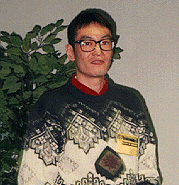
KATSURA
MASAKAZU, CREATOR AND ARTIST
of successful manga titles such as Video Girl Ai and DNA^2, arrived at
Katsucon to a very welcoming crowd. It was his first appearance in the
United States and his initial apprehension showed. Through two hour-long
panels, Katsura fielded questions from the room. He seemed a bit nervous
at first but, as he sat down and became more comfortable with the
audience, Katsura overcame his initial awkwardness and provided an
entertaining seminar.
 Mr. Katsura admitted that he became
interested in manga art early in his life. How he became involved is
another matter, though. Initially, as a junior high school student, he
was more interested in real art and drew accordingly. However, a fellow
student was involved in drawing manga-style art and received many
compliments from the teacher. Whether it be from envy or a chance to
gain the teacher's favor, Katsura decided to try drawing manga-style
from then on. Katsura gave a little laugh, noting that, to the best of
his knowledge, that fellow student was not involved in the manga
industry at the present time. Mr. Katsura admitted that he became
interested in manga art early in his life. How he became involved is
another matter, though. Initially, as a junior high school student, he
was more interested in real art and drew accordingly. However, a fellow
student was involved in drawing manga-style art and received many
compliments from the teacher. Whether it be from envy or a chance to
gain the teacher's favor, Katsura decided to try drawing manga-style
from then on. Katsura gave a little laugh, noting that, to the best of
his knowledge, that fellow student was not involved in the manga
industry at the present time.
His involvement with manga art heightened
in high school when the manga magazine Weekly Shonen Jump offered the
Tezuka Award competition. A contest for amateur artists, The Tezuka
Award offered a home stereo as first prize, something Katsura wanted
badly. His entry did not win. But, determined to be noticed, Katsura
continued to submit pieces of his work until the editors of Weekly
Shonen Jump finally caved in and hired him. Was it perseverance or
obsession?
Katsura's first work was Wingman.
Following works include Video Girl Ai and DNA^2. His latest work is the
manga title Shadowlady. Katsura's works are known for their subtle
hentai content, which he finds somewhat regrettable. When Weekly Shonen
Jump recently reissued some of his works, some of the "offensive" art
was altered to tone it down. Katsura wasn't opposed to the change but
what irked him was what brought about the change. "The people who
complained about the original art were superficial. They saw some of
the art that was offensive in nature. They weren't people who were
actual readers of the manga."
What surfaced about Katsura were some of his influences on his art and
style. Surprisingly, much of his influence were more of Hollywood films
rather than other manga artists. One particular source is Batman--both
the movies and comic books. Katsura stated that he enjoyed the world of
Batman, mainly Gotham City and the way it is portrayed. As for other
manga artists, Katsura couldn't really name any that were of influence
to him, except one. Toriyama Akira, creator and artist of the Dragonball
series, did play some inspiration to Katsura. It was pointed out to
Katsura that the hairstyles of his work and that of Toriyama's are quite
similar. Katsura then acknowledged that perhaps there is an influence.
He revealed that the two talk every now and then on the phone and
discuss life, taxes, and everything under the sun.
Katsura discussed the origins of some of
his works. Along with DNA^2, Video Girl Ai is one of Katsura's most
popular works. While brainstorming with the editors of Weekly Shonen
Jump for a new manga series, it was decided that the basis of the new
series would be a love story. But Katsura wanted to interject science
fiction in to the story. The idea for Video Girl Ai was decided upon
when Katsura saw an episode of Amazing Stories, the American series
loosely based on the Twilight Zone. In the episode, a girl came to life
out of a song from a record. At that time in Japan, video rentals were
on the rise and then the idea struck Katsura. The girl would come to
life from a videotape. And the rest was manga history. When asked to
personally choice which one of his works is his favorite, Katsura caved
in and decided on Video Girl Ai. However, Katsura was quick to point
out that he's not really satisfied with any of his works. To him, the
ideas that are dreamed up in his head differ from the actual product.
(continued).
|

